About this service
When to contact us
What the work includes
Related pages
Understand it first, then decide what to treat
A damp patch can come from very different places: moist indoor air settling on a cold wall, a window reveal that loses more heat than the rest of the room, a pipe weeping behind the tiles, or water that got in months ago and is still working its way out. From the outside, several of those look almost the same.
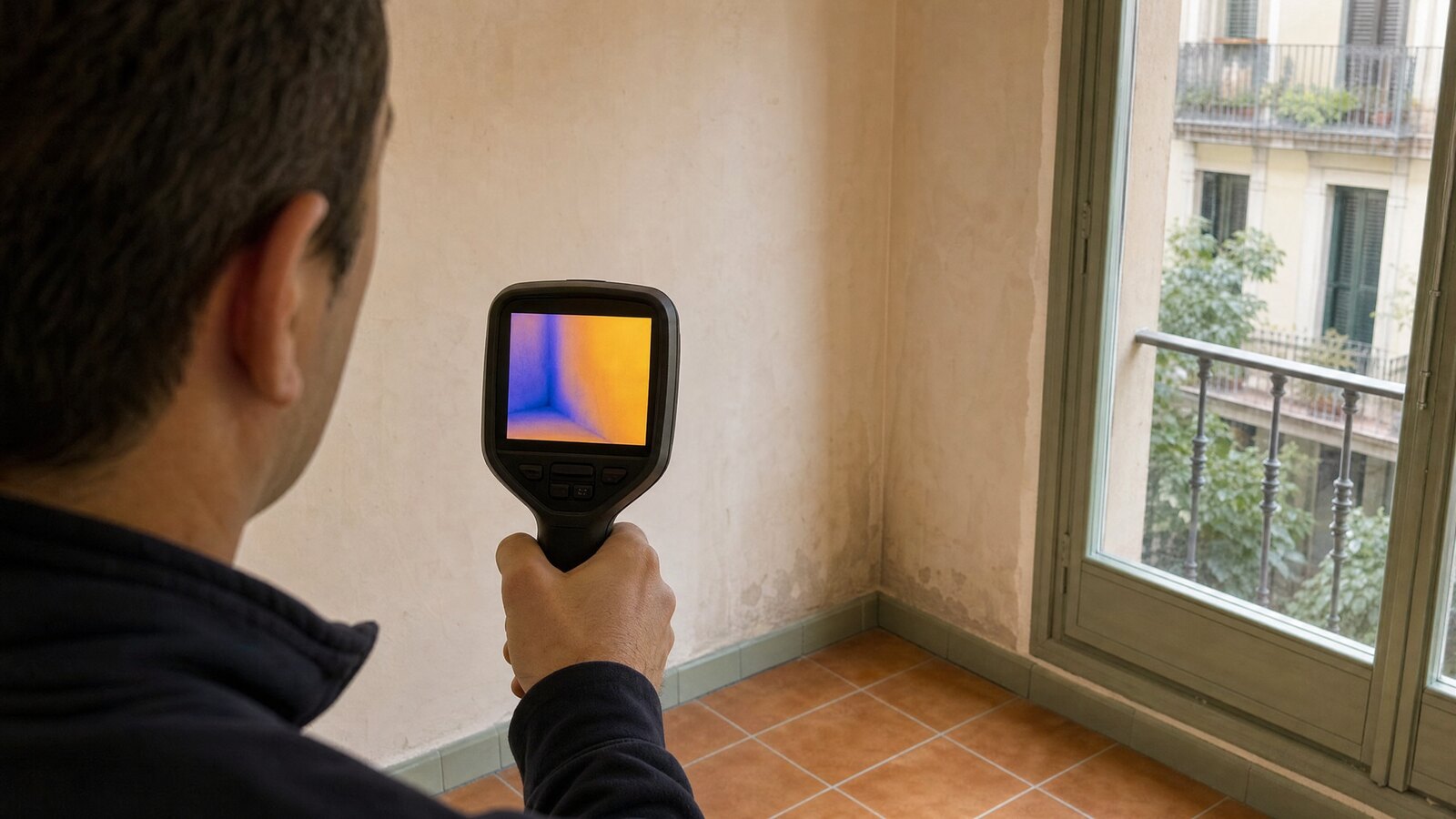
That is why this service does not start with a treatment. It starts with a visit to look at the area properly with a thermal imaging camera: how surface temperature is spread across it, where the coldest spots are, and whether the pattern follows a corner, a beam, the outline of a window or the likely route of a pipe. With that, plus what can be seen and what you tell us, the next step is decided on much firmer ground than a single photo.
If the case is already clear — visible condensation mould in a bedroom, say — there is no point paying for a survey. Photos are usually enough, and you can go straight to mould removal. A survey is worth it when the real question is “where is this coming from?”
What a thermal camera measures — and what it doesn’t
Thermal imaging measures surface temperature: the infrared radiation each point of the wall gives off, turned into a colour image with temperature values. We use a professional camera (testo 868s) that records a thermal image and a normal photo of the same spot, so the two can be compared and documented.
That makes differences visible that the eye cannot see. A damp area often reads slightly cooler than its surroundings because evaporating water cools the surface; thermal bridging shows up as a cold band following a column, a slab edge or a window frame. But to be clear: the camera does not measure the moisture inside a material, the humidity of the air or the dew point. What it shows are temperature patterns consistent with one cause or another, which have to be read in context.
Conditions matter too. A survey of a flat reads best when there is a temperature difference between inside and outside, so in Barcelona the colder months usually give clearer images. Sun on the façade, heating that has just come on, and reflections on glass or glazed tiles can mislead if nobody accounts for them — separating a real signal from a reflection is part of the job.
When a survey is worth it
These are the situations where a visit with the camera usually tells us more than photos:
- a mark that comes back in the same place after cleaning, treatment or repainting
- damp on a wall nowhere near a bathroom or kitchen, with no obvious source
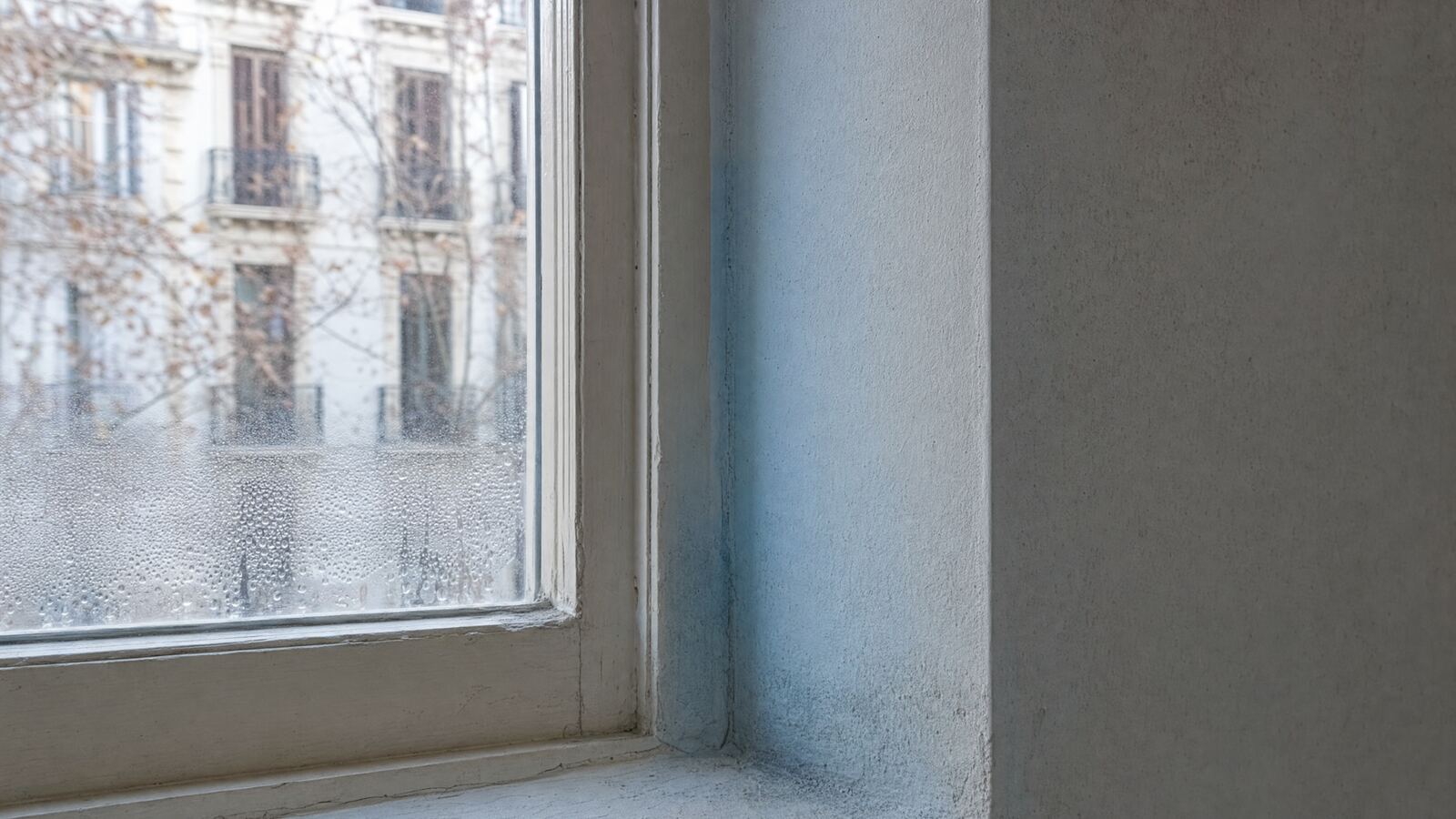
- a corner or window reveal that marks every winter, and you want to know whether it is a cold spot in the building
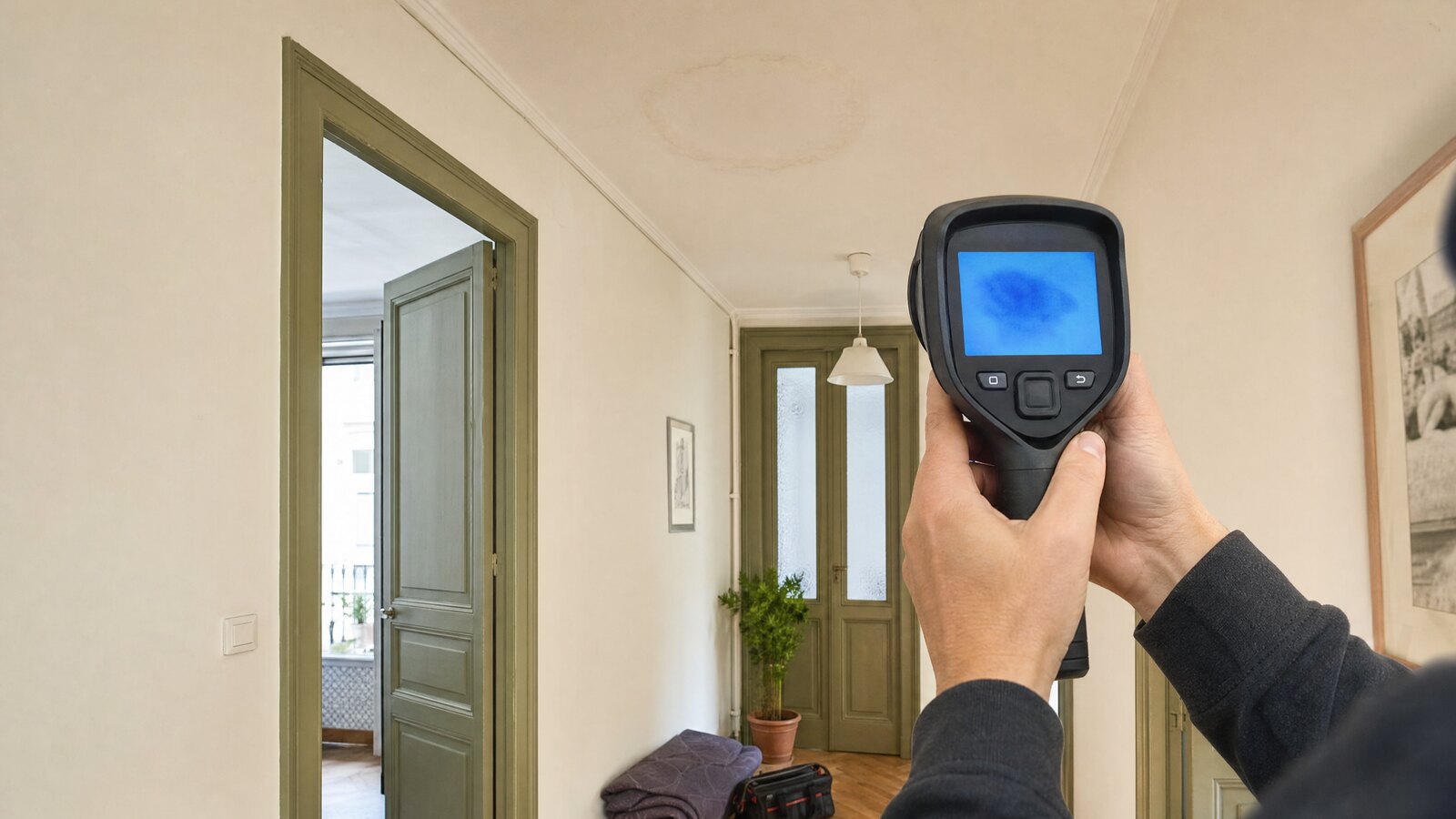
- a ceiling stain after a neighbour’s leak was fixed, and you are not sure the problem has stopped
- a musty smell without a clear mark, or several rooms affected at once
- before paying for expensive damp-proofing work that someone has quoted you for, when you want an independent reading first
If it is only steamed-up windows and a small mark that has just appeared, start with condensation mould — watching the room for a few days is often enough.
Photos on WhatsApp or a survey visit
| Photos on WhatsApp | Thermal imaging survey visit | |
|---|---|---|
| What is assessed | What is visible: appearance, size, location, state of the paint | The visible surface plus how its temperature is spread across the whole area |
| What it is for | Sorting the case and deciding whether it fits our work | Telling apart causes that look alike, and seeing the real extent before any work |
| Limit | Cannot show what is happening beyond the surface | Does not measure moisture inside the wall and does not replace a plumber or a roofer |
| Outcome | A WhatsApp reply with the next step | An explanation on site and, if you want it, a written survey summary |
The two work together: we almost always start with photos, and suggest a visit only when it will change the decision.
What happens on the visit
- Background. You tell us the story: when it appeared, whether it comes back, what has been tried, and any leaks, building work or new windows. Where it is accessible and relevant, we also look at the next room, the façade or the flat above.
- Walk-round with the camera. We look at the affected area and its surroundings — not just the stain — comparing it with sound walls of the same material, and record thermal images and normal photos of the spots that matter.
- Reading on site. We explain the patterns we saw and what they suggest: a cold spot tied to the building’s geometry, a pattern following a service run, a surface still colder than its surroundings after a leak, or nothing remarkable.
- Next step. What we can treat, what another trade should check first, and what is best simply watched.
The written survey summary
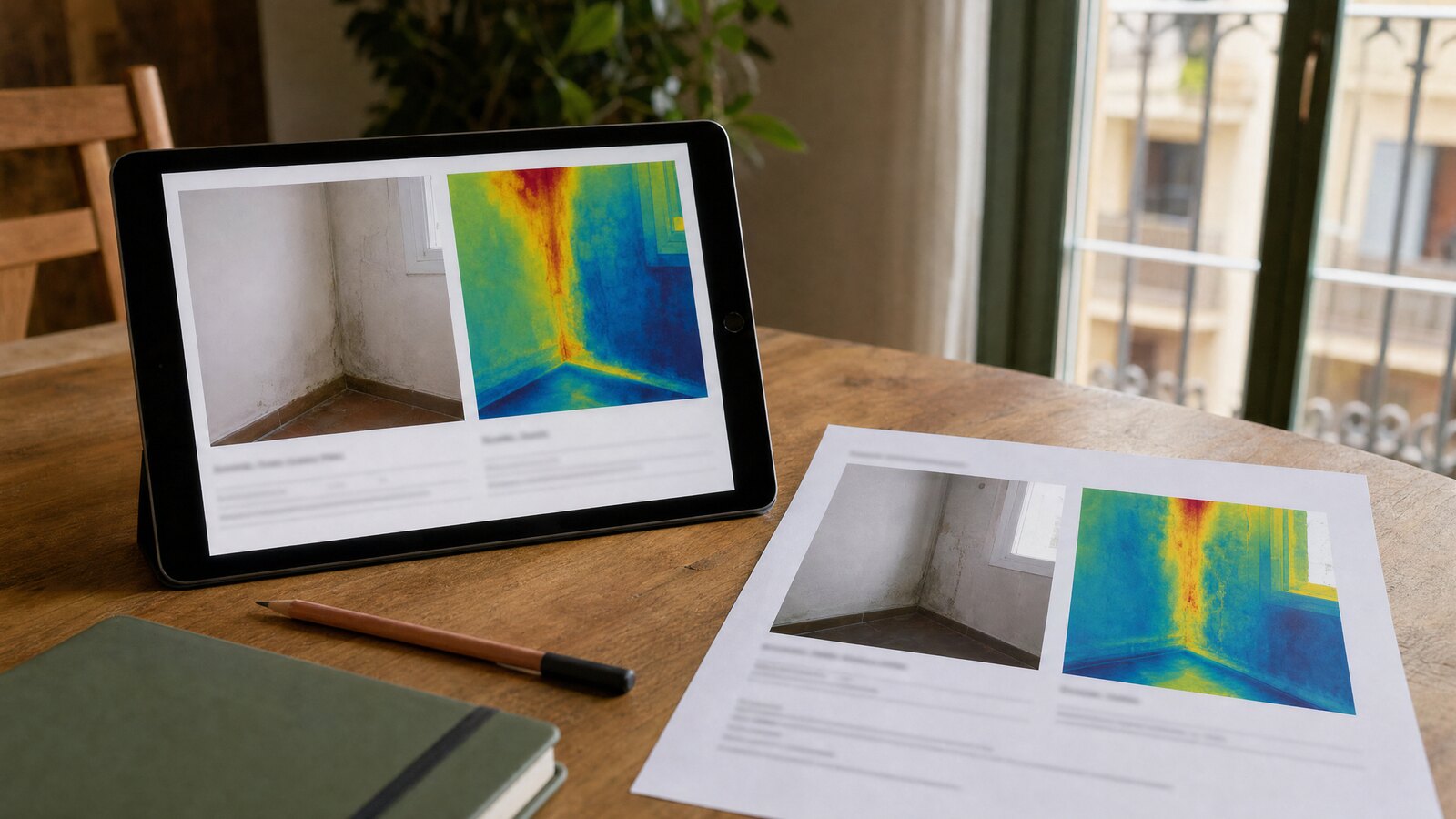
If you need it — for yourself, your landlord, the comunidad or whoever will do the work — we prepare a written summary with:
- normal photos and thermal images of the areas checked
- the date, time and conditions of the visit (approximate indoor and outdoor temperatures, sun, heating)
- the temperature patterns observed and where they are
- the risk areas identified, such as cold junctions or surfaces with patterns consistent with damp
- the recommended next step and which trade it belongs to
It is a descriptive technical document to help you understand and explain the case. It is not an expert witness report (informe pericial), it is not a certificate, and it carries no legal or insurance standing of its own; if you need an expert report for a claim, that is signed by a qualified expert (perito) or a professional registered with their Spanish professional body.
What this service is not
- It is not leak detection or plumbing: if there are signs of a leak, the outcome is a recommendation that a plumber (fontanero) or leak-detection company checks it, with what we already know.
- It does not certify that a wall has dried out after a leak: the camera helps show whether an area still behaves differently, but drying is confirmed with time and other checks.
- It is not a building-regulation calculation: Spain’s building code (CTE) deals with thermal bridging and surface condensation at design stage, and a survey of a flat is not that calculation.
- It is not damp-proofing, injection treatment for rising damp, façade work or structural repair.
Where we work
We do survey visits in Barcelona and across the same area as our other services: the metropolitan area (including Cornellà de Llobregat, Sant Boi de Llobregat, L’Hospitalet and Badalona), the Vallès and both stretches of coast. Outside the city we confirm availability once we have seen the photos.
How to ask on WhatsApp
Send two or three photos — a wide shot of the room, a close-up of the area and, if you can, the wall or ceiling around it — and tell us briefly:
- exactly where it shows (outside wall, corner, beside a window, ceiling, low on the wall)
- whether it comes back every winter or after painting
- whether there has been a leak, and whether it has been repaired
From that we can tell you whether photos are enough or whether a survey visit will actually add something.